
- All
- Product Name
- Product Keyword
- Product Model
- Product Summary
- Product Description
- Multi Field Search


Views: 0 Author: Site Editor Publish Time: 2026-11-02 Origin: Site


The Epiroc Scooptram ST7 operates as a powerhouse high-production underground loader. However, its daily uptime heavily relies on the sheer integrity of its bucket. When operators install mismatched wear parts, they trigger accelerated structural degradation. You will likely experience unplanned maintenance intervals. Your cost-per-ton metrics will rise sharply across the fleet. We built this guide to tackle these specific challenges. Our goal is to provide a pragmatic, engineering-aligned framework for your maintenance teams. You will learn exactly how to evaluate, specify, and match the correct ground engaging tools. We will help you align these choices to your specific underground mining conditions. Applying these principles prevents catastrophic bucket failures. It keeps your production schedules running smoothly. You avoid sudden mid-shift breakdowns. Protecting the base shell remains critical for long-term profitability. By selecting the right profiles, you optimize penetration effortlessly. You also extend the overall equipment lifespan. Let us explore the mechanics of choosing the perfect wear package for your underground operation.
Selecting wear parts requires balancing material hardness (abrasion resistance) with material toughness (impact resistance) based on the specific geological profile.
Core ST7 wear profiles typically include lip shrouds, heel blocks, and corner protectors; neglecting one accelerates wear on the others.
Replacement thresholds should be driven by measurable wear limits rather than subjective visual inspections to prevent costly base-bucket rebuilds.
Incorrect profile selection dramatically increases penetration resistance. When a bucket struggles to enter the muck pile, you burn significantly more fuel. Hydraulic cylinders experience severe strain during each loading cycle. This resistance forces the loader to work much harder. The engine runs hotter. Component fatigue accelerates rapidly. Consequently, your operational costs rise. Choosing improper profiles effectively limits the machine's true potential. You end up moving less rock while burning more diesel. Proper matching ensures a smooth digging motion.
You must view Epiroc ST7 bucket wear parts as sacrificial components. Engineers design them specifically to absorb kinetic energy. They handle all abrasive friction. They act as a heavy-duty shield. They protect the highly expensive base lip and shell. Without them, abrasive ore quickly grinds away the structural steel. Replacing a base lip costs significantly more. It also demands extensive fabrication time. Proper shrouds take the beating so your bucket survives.
Frequent replacement events disrupt shift productivity severely. A sudden weld-on job midway through a shift halts production entirely. Transporting welding equipment underground takes valuable time. The disruption costs far exceed the actual part price. Unplanned mechanical replacements delay tramming operations. They cause frustrating bottlenecks in narrow drift environments. Proactive matching prevents these expensive downtime multipliers. You keep the machine loading rather than sitting in the maintenance bay.
When selecting Scooptram ST7 replacement parts, you must evaluate mechanical versus weld-on configurations. Mechanical pin-on systems offer rapid replacement speeds. A technician can swap them directly at the drawpoint. Weld-on lips provide superior retention security. They excel in high-vibration environments. Pins might shear under extreme impact. You must weigh replacement speed against retention reliability. Mechanical systems cost more upfront. However, they save massive amounts of labor hours later.
Heel blocks play a critical role. They protect the lower bucket radiuses. Corner protectors guard the most vulnerable leading edges. These specific areas experience extreme friction. As the bucket drags across the uneven drift floor, they take the brunt of the abrasion. Neglecting them exposes the structural corners. Once the corners wear thin, the entire bucket loses its structural rigidity. You must maintain these edge protectors religiously.
You can utilize mechanically attached or welded wear liners. We see them inside and outside the bucket. Chromium Carbide overlays deliver exceptional sliding abrasion resistance. Quenched and Tempered steel plates provide better impact resistance. Choosing the right liner stops the bucket floor from wearing through.
Common liner configurations include:
Chromium Carbide Overlays: Best for high-abrasion environments. They handle quartz heavily.
Quenched and Tempered Plates: Ideal for absorbing heavy shock. They handle blasted rock well.
Bolt-on Liners: Allow fast change-outs. You bypass hot work permits entirely.
Half-Arrow Edges: Provide extra material on the leading edge. They protect the weld seams.
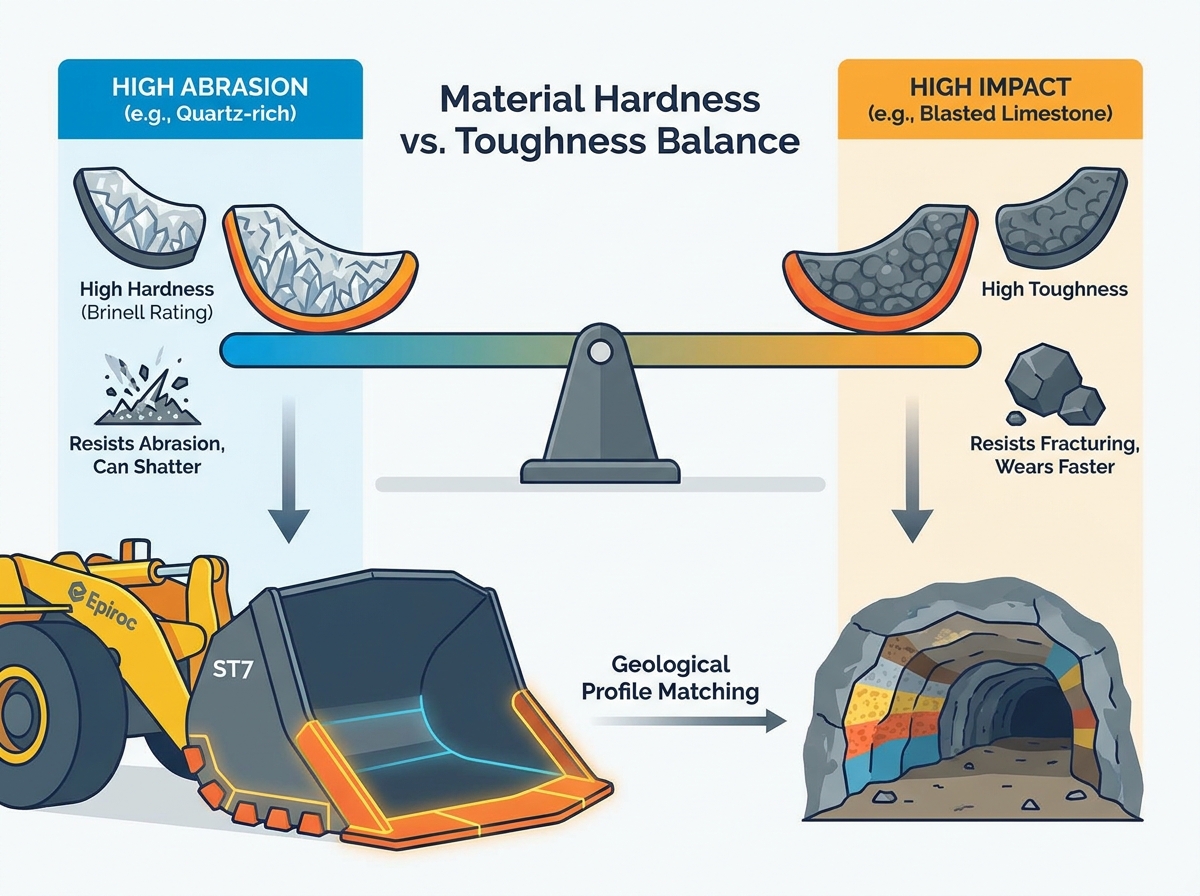
Mining geology dictates your material choices absolutely. We categorize environments on a wide spectrum. Highly abrasive conditions feature quartz-rich rock. High-impact environments involve large blasted limestone.
You must understand the relationship between hardness and toughness. High hardness (Brinell rating) resists abrasion effectively. However, overly hard steel can shatter easily under high impact. Toughness resists fracturing entirely. Yet, tough steel wears much faster in abrasive muck. You cannot have maximum hardness and maximum toughness simultaneously.
Geological Profile | Primary Challenge | Recommended Material Property |
|---|---|---|
Quartz-rich Ore | Severe Sliding Abrasion | High Brinell Hardness (500+ HBW) |
Blasted Limestone | Heavy Shock Load | High Toughness (Impact Resistant) |
Mixed Hard Rock | Variable Wear | Balanced Quenched & Tempered Steel |
Wet Abrasive Muck | Corrosion and Abrasion | Chromium Carbide Overlays |
Fleet managers frequently weigh OEM systems against specialized aftermarket loader bucket wear parts. You must evaluate them objectively. Look closely at metallurgical consistency across batches. Check local availability to prevent dangerous inventory shortages. Many premium alternative systems offer specific mine-site adaptations. They might feature reinforced shrouds tailored for your exact ore type. Demand actual performance data. Ask for case studies from similar rock conditions. Premium suppliers should readily provide ISO certifications for their casting processes. This transparency builds trust and ensures reliable components.
Thicker wear profiles undoubtedly increase overall lifespan. They put more steel between the ore and the bucket lip. However, thick profiles reduce muckpile penetration efficiency. A blunt edge struggles to cut into the pile. The loader tires spin. This reduction decreases your payload per pass. You must find the optimal balance. Extending wear life means little if your loader moves significantly less ore each shift.
You cannot rely on subjective visual inspections alone. You need measurable threshold metrics. Maintenance teams should measure the remaining millimeter thickness on the lip. They must monitor wear pattern encroachment on the parent metal. Once the wear reaches a predetermined limit, you swap the parts immediately. Using ultrasonic thickness gauges provides objective data. You can also use custom wear templates. Holding these metal cutouts against the worn shroud shows exactly how much material has vanished. This removes all guesswork from your maintenance program.
Running wear parts to absolute destruction triggers cascading failures. When you wait too long, you risk cracking the main lip. This damage often requires expensive line-boring. In severe cases, you face a complete bucket replacement. A delayed swap of a simple shroud can ruin a fifty-thousand-dollar asset. Do not risk the base structure. Protect the shell at all costs.
We strongly advocate for standardized inspection intervals. You should align these checks with standard PM (Preventative Maintenance) schedules. Grouping hot-work or mechanical change-outs minimizes production interruptions. Run-to-fail strategies fail miserably in underground mining. They guarantee sudden breakdowns during peak production hours. Scheduled maintenance ensures you control the downtime. You dictate exactly when the machine stops.
Before requesting bids, you must gather precise operational data. Suppliers need this information. It helps them recommend the proper ST7 bucket ground engaging tools. You should never order parts blindly.
Provide these essential data points to your vendor:
Rock Abrasiveness Index: Indicates the sliding wear severity.
Bucket Payload Capacity: Dictates the structural load limits during tramming.
Average Hours Per Shift: Helps calculate expected component lifespan.
Current Failure Modes: Highlights exactly where previous parts failed prematurely.
Operating Temperatures: Affects the metallurgy choices in deep underground mines.
Testing a new wear package requires a structured framework. First, isolate one ST7 unit for the test. Track the exact tons moved by this machine. Record the fuel burn carefully. Measure the wear rates at set hour intervals. Comparing these metrics against your baseline reveals the true performance. Avoid running multiple variables simultaneously. Keep the operator and the heading constant. Changing operators introduces human variables. Different driving habits skew fuel consumption data. Consistency guarantees clean data for your final analysis.
Ask key questions when evaluating potential suppliers. Inquire about their warranty terms for premature breakage. Request their metallurgical testing reports. You need to verify steel quality independently. Assess their local stocking capabilities. A supplier must mitigate your supply chain risks. If they cannot deliver parts locally, you face extended machine downtime. Reliable partners stock parts near your shaft.
Treating your bucket wear parts as engineered systems brings massive strategic value. They are not simple commodity consumables. They directly dictate your loading efficiency and asset longevity. The optimal match always requires a compromise. You must balance maximum wear life, optimal penetration, and maintenance predictability. We advise fleet managers to act proactively. Initiate a bucket wear audit today. Baseline your current performance before requesting any new procurement bids. Understanding your current baseline guarantees better purchasing decisions tomorrow. Protect your Scooptram ST7 and maximize your underground yields.
A: You should perform a basic visual check before every single shift. Operators must look for missing pins, severe cracks, or dislodged shrouds. For precise tracking, maintenance personnel should conduct weekly caliper measurements. This frequency adapts based on your rock type. Highly abrasive quartz requires closer monitoring than softer limestone environments.
A: We strongly advise against mixing different brands. Mismatched profiles introduce severe mechanical risks. You will likely experience uneven wear across the bucket lip. Fitment tolerances rarely align perfectly between manufacturers. This mismatch compromises penetration efficiency. It often causes premature locking pin failures during heavy loading cycles.
A: Weld-on parts require significant installation downtime for gouging and welding. However, they offer ultimate retention in high-impact zones. Mechanically attached systems carry a higher upfront cost. Yet, they allow much faster change-outs directly in the drift. You eliminate the need for complex hot-work permits and specialized welding equipment.
A: You must watch for critical structural red flags. If you observe compromised structural welds along the boom mounts, the bucket requires immediate attention. Severe base lip distortion prevents new shrouds from fitting properly. Deep cracks extending into the main bucket shell usually indicate the asset is beyond economical repair.
