
- All
- Product Name
- Product Keyword
- Product Model
- Product Summary
- Product Description
- Multi Field Search


Views: 0 Author: Site Editor Publish Time: 2026-08-03 Origin: Site


Underground extraction operates in a high-stakes environment where equipment failure directly impacts daily tonnage, site safety, and overall mine profitability. Mine managers constantly balance the need to maximize payload capacity against strict operational constraints. Narrow vein dimensions, steep ramp gradients, and limited ventilation capacities dictate exactly what machinery can physically operate below the surface.
Selecting the right machinery requires a deep understanding of mine design and geological limitations. Procurement teams cannot simply buy off-the-shelf surface equipment and expect it to perform underground. This guide provides a technical evaluation framework for mine operators and engineers. It categorizes the primary types of machinery used below ground and delivers actionable criteria to assess and select the optimal mix of equipment for specific ore bodies, ensuring smooth traffic flow and maximum extraction rates.
Fleet Synergy is Critical: Maximum efficiency is achieved when Load-Haul-Dump (LHD) loaders are precisely matched to the capacity of underground haul trucks (e.g., achieving a standard three-pass loading cycle).
Ventilation Dictates Powertrain: The shift toward Battery Electric Vehicles (BEVs) is accelerating primarily to reduce secondary ventilation costs and eliminate diesel particulate matter (DPM), though diesel remains dominant for remote or infrastructure-limited sites.
Size to the Stope: Selecting specific capacities, such as a 15 ton underground mining truck, requires calculating exact drift dimensions, turning radii, and ramp gradients to prevent bottlenecking.
The physical dimensions of any Underground Mining Vehicle are strictly dictated by the mine's drift profiles and ramp gradients. Width and height clearances determine the maximum allowable size of the machinery. A vehicle that is too large will suffer from restricted mobility, increased collision risks, and accelerated wear on tires and chassis components. Engineers map the entire haulage route, accounting for the tightest intersections and lowest ventilation ducting, to establish a hard limit on equipment dimensions before procurement begins. You must measure the exact turning radius at every switchback. If a truck requires a multi-point turn to navigate a ramp, cycle times will plummet.
To illustrate the relationship between drift size and equipment selection, consider the following baseline clearance requirements:
Drift Profile (Width x Height) | Typical Equipment Class | Minimum Turning Radius Required | Primary Application |
|---|---|---|---|
3.0m x 3.0m | Low-Profile LHD (1-3 cubic meters) | Inner: 2.5m / Outer: 4.8m | Narrow vein mining, tight development headings |
4.0m x 4.0m | Mid-Sized Haul Truck (15-20 Ton) | Inner: 3.2m / Outer: 6.0m | Standard hard rock development, medium stopes |
5.0m x 5.0m+ | Large Articulated Truck (30-40+ Ton) | Inner: 4.5m / Outer: 8.5m | Main haulage ramps, large-scale block caving |
Mine ventilation capacities place a hard ceiling on the total engine kilowatts that can operate in a specific heading simultaneously. Diesel engines consume massive amounts of ambient air and reject significant heat and exhaust into the confined environment. Evaluating low-emission or zero-emission engines is a strict operational necessity to keep temperatures manageable and ensure breathable air for personnel working at the face. When a mine reaches a certain depth, the cost of pushing fresh air down the shaft exceeds the cost of upgrading the fleet. You must calculate the exact airflow requirements (typically measured in cubic feet per minute per brake horsepower) for every piece of diesel equipment on the asset register.
Efficiency in underground haulage is measured by the payload-to-weight ratio. This metric evaluates how much dead weight the vehicle must move relative to the ore it transports. A high ratio indicates that energy is being used primarily to move valuable rock rather than heavy steel. Optimizing this ratio reduces fuel consumption, extends tire life, and maximizes the volume of ore extracted per operational hour. Heavy, over-engineered frames might survive impacts better, but they burn excess fuel on every empty return trip up the ramp.
Confined spaces require exceptional maneuverability. Articulation angles and turning radii dictate how well a machine navigates tight intersections, switchbacks, and narrow stopes. Vehicles must position themselves accurately for loading and dumping without requiring excessive multi-point turns, which degrade cycle times and increase operator fatigue. Center-articulated steering is standard across the industry, allowing the front and rear frames to track in the exact same path, minimizing wall strikes and tire sidewall damage.
The regulatory environment dictates specific vehicle configurations based on the geology of the mine. Hard rock mining focuses heavily on robust chassis design and impact resistance. Soft rock and coal mining operate in gassy environments, necessitating stringent flameproof and explosion-proof certifications. Compliance with regulatory bodies ensures that electrical systems, exhaust manifolds, and braking mechanisms cannot act as ignition sources in methane-rich atmospheres. You cannot deploy standard hard rock equipment into a coal seam without risking catastrophic atmospheric ignition.
LHDs are the primary extraction machines, engineered specifically for mucking out blasted rock in confined headings. Their low-profile, articulated design allows them to operate in tunnels with minimal headroom while maintaining exceptional breakout force. LHDs dig into the muck pile, load the bucket, and tram the material away from the face. Evaluation metrics for LHDs include hydraulic breakout force, bucket capacity measured in cubic meters, and maximum tramming capacity. Operators weigh the trade-offs between using LHDs for direct tramming to ore passes over short distances versus using them strictly to load haul trucks for longer transport routes.
To maximize LHD efficiency at the drawpoint, operators follow a strict sequence:
Approach the muck pile squarely to ensure even tire wear and maximum traction.
Drop the bucket flat to the floor just before contacting the blasted rock.
Apply steady throttle while simultaneously curling the bucket to utilize hydraulic breakout force rather than relying solely on wheel traction.
Retract the boom slightly to settle the load and prevent spillage during tramming.
Reverse out of the drawpoint using the articulated steering to align with the haulage drift.
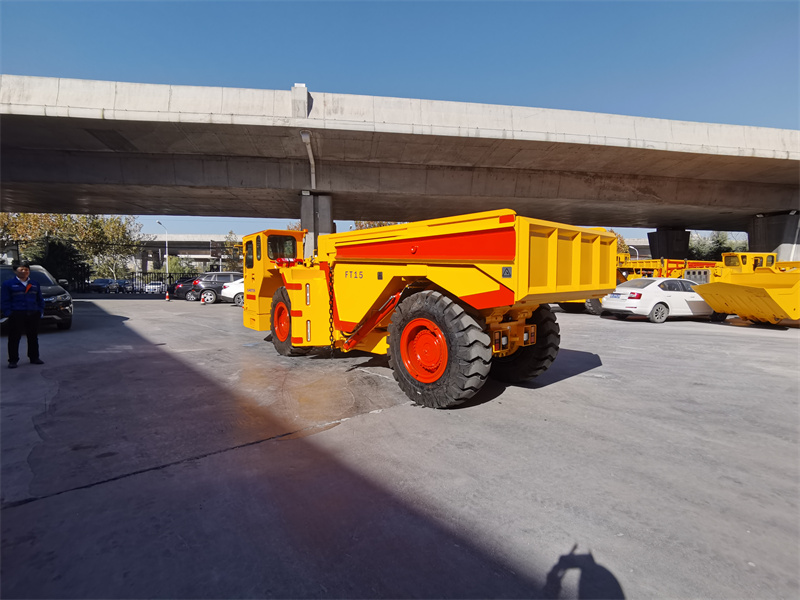
Underground rock trucks are fundamentally different from surface dump trucks. They feature a low-profile, articulated chassis designed to navigate steep declines and tight corners. Surface equipment is entirely irrelevant in this context. Capacity benchmarks vary widely based on the mine's scale. For mid-sized or narrow-vein operations, a 15 Ton Underground Mining Truck serves as an ideal evaluation model. It offers a balance of payload capacity and agility, requiring specific ramp speeds and drift clearances to operate effectively. Operations with severe height restrictions at the dump point often replace standard tipping boxes with ejector boxes, which push the material out horizontally without raising the bed.
In continuous mining operations, particularly within coal and soft rock environments, shuttle cars play a vital role. These low-profile vehicles interface directly with continuous miners, receiving extracted material and transferring it over short distances to conveyor belt systems. For niche cleanup tasks and narrow-vein mucking where traditional LHD access is physically restricted, slusher and scraper systems are deployed. These cable-drawn buckets drag ore out of tight stopes, providing a mechanical solution for areas that cannot accommodate wheeled vehicles.
Drilling equipment is categorized by its primary function: development or production. Face drills, commonly known as jumbos, are used for advancing tunnels horizontally. They drill precise patterns into the rock face for explosives placement. Production drills, or longhole drills, are used for stoping, drilling deep vertical or inclined holes to blast large volumes of ore. Technical specifications for these machines focus on boom coverage, drill feed lengths, and the integration of automated drilling patterns, such as Measurement While Drilling (MWD) technology, which optimizes hole accuracy and explosive efficiency.
A productive mine requires a fleet of specialized support machinery. Personnel transport vehicles, or manhaulers, are built with heavy-duty suspensions, enclosed cabins, and specialized seating to move crews safely through rough, steep declines. Utility and scissor lifts provide elevated platforms for explosive charging, pipe hanging, and electrical installations. Ground support equipment, including mechanized rock bolters and shotcrete sprayers, is mandatory for reinforcing tunnel walls and maintaining structural integrity. For specialized material handling, electric monorail cranes are often installed along fixed overhead tracks to transport heavy components without congesting the drift floor.
Modern diesel engines remain prevalent due to their proven reliability, high energy density, and ease of refueling. Advanced diesel systems are equipped with specially built, low-emission engines that utilize scrubbers, diesel particulate filters, and exhaust cooling systems to comply with stringent underground air-quality standards. Despite these mitigations, diesel equipment places a heavy burden on mine ventilation infrastructure. The continuous generation of heat and diesel particulate matter requires massive fans and extensive ducting to maintain a safe working environment. You have to factor in the cost of transporting diesel fuel underground, storing it safely in fire-suppressed bays, and managing the inevitable spills that occur during rapid refueling.
The transition to Battery Electric Vehicles offers profound operational advantages. BEVs eliminate exhaust emissions entirely, drastically reducing the demand on secondary ventilation systems. They generate significantly less heat and noise, improving operator comfort and safety. Electric motors deliver instant high torque at low speeds, which is highly advantageous for climbing steep ramps fully loaded. BEV adoption presents logistical challenges. Mines must invest heavily in upgraded electrical reticulation, install specialized charging stations, and manage complex battery swapping logistics to ensure continuous operation without extended downtime. You cannot simply plug a 40-ton loader into a standard wall outlet; these machines require dedicated, high-voltage substations excavated near the active working areas.
Maximizing haulage efficiency requires a precise volumetric and weight match between loaders and trucks. The industry standard dictates a three-to-four pass loading rule. If an LHD requires more than four passes to fill a truck, the loader is undersized, resulting in excessive truck idle time. If a loader fills a truck in one or two passes, the truck is likely undersized, causing the loader to wait for the next empty vehicle. Proper pairing ensures a continuous, fluid loading cycle that maximizes the utilization of both machines. You must also account for the swell factor of the blasted rock; a bucket rated for three cubic meters of solid rock will hold significantly less actual weight once the material is fragmented.
Calculating round-trip cycle times is essential for determining the required fleet size. This analysis must account for ramp gradients, payload capacities, and dump point logistics. Maximizing the efficiency of a 15 Ton Underground Mining Truck requires evaluating its loaded speed up a 15% grade, the time required to maneuver at the loading point, and the clearance available for dumping. Accurate cycle time models allow engineers to predict tonnage output per shift and identify potential bottlenecks in the haulage route.
A standard cycle time calculation includes the following distinct phases:
Queue Time: The duration the truck waits at the drawpoint for the LHD to become available.
Spotting Time: The seconds required for the truck to reverse into the exact loading position.
Loading Time: The duration of the three-to-four pass LHD cycle.
Loaded Haul: The transit time up the ramp to the stockpile or crusher, heavily dependent on engine torque and grade.
Dumping Time: The time taken to position, raise the box (or engage the ejector), and clear the material.
Empty Return: The transit time back down the ramp to the active heading.
As a mine deepens and haulage distances increase, the initial fleet composition must adapt. Longer tramming distances reduce the number of cycles a truck can complete per shift, necessitating either larger capacity vehicles or an increased number of units. Fleet scalability requires forward-looking procurement strategies, ensuring that the Mining Equipment purchased during the development phase can either be integrated into production haulage or replaced efficiently without requiring massive modifications to existing mine infrastructure.
Servicing heavy machinery in underground environments presents significant logistical hurdles. Maintenance bays are confined, poorly lit, and exposed to highly abrasive dust and moisture. Equipment must be designed with accessible service points, allowing technicians to perform routine hydraulic and engine maintenance safely and efficiently. Machines that require extensive disassembly for basic servicing will suffer from prolonged downtime, directly impacting production schedules. Mechanics need ground-level access to fluid filters, grease points, and diagnostic ports to keep turnaround times low.
Operator fatigue is a major risk factor in underground mining. Cabin designs must incorporate Roll-Over Protective Structures (ROPS) and Falling Object Protective Structures (FOPS) to shield operators from rockfalls and collisions. Vibration dampening seats, climate control, and advanced camera systems are mandatory for mitigating the physical toll of navigating rough terrain and overcoming the inherent visibility constraints of low-profile machinery. A comfortable operator maintains faster cycle times and makes fewer errors during a twelve-hour shift.
The industry is rapidly transitioning from manual operation to tele-remote and fully autonomous systems. Line-of-sight remote control allows operators to manage LHDs from a safe distance during hazardous mucking operations. Advanced systems enable autonomous tramming and dumping, where vehicles navigate predefined routes using laser scanners and sensors. Procurement criteria must evaluate whether new machinery is automation-ready, ensuring that the fleet can integrate with future digital mine management platforms without requiring costly retrofits.
Procuring the right underground fleet requires matching machine specifications directly to the physical and environmental realities of the mine. You cannot force oversized equipment into narrow drifts, nor can you ignore the ventilation limits imposed by heavy diesel usage.
Conduct a comprehensive 3D simulation of your mine's drift profiles and intersections to verify equipment clearance and turning radii before procurement.
Audit your current ventilation capacity to determine the maximum allowable engine kilowatts or to justify the infrastructure investment required for a BEV fleet.
Model round-trip cycle times based on precise ramp gradients and dump point logistics to establish the exact number of trucks and loaders required to meet daily tonnage goals.
Standardize fleet components where possible to simplify maintenance procedures and reduce the volume of spare parts required in underground inventory.
A: An LHD (Load-Haul-Dump) loader is a specialized, low-profile vehicle with an articulated chassis. Its primary function is to muck out blasted ore from confined headings, load the material into its bucket, and tram it either to an ore pass or directly into a haul truck.
A: Underground trucks feature a low-profile, articulated design to navigate tight tunnels and steep declines. They are equipped with specialized exhaust cooling and filtration systems to manage emissions in confined spaces, whereas surface trucks are rigid-framed and significantly taller.
A: This capacity is ideal for narrow-vein mining, mid-sized development headings, and operations with restricted turning radii. It provides a balance of payload efficiency and maneuverability where larger 30-ton or 40-ton trucks physically cannot operate.
A: BEVs eliminate diesel exhaust emissions and diesel particulate matter, drastically reducing the need for costly secondary ventilation. They also generate less heat and noise while providing high torque for climbing steep ramps.
A: Shuttle cars are used primarily in coal and soft-rock mines for continuous, short-distance transit between a continuous miner and a conveyor. Haul trucks are used in hard-rock mines for high-capacity, long-distance transport up steep ramps to the surface or a crusher.
A: Matching involves aligning the loader's bucket capacity and weight limits with the truck's payload box. The industry standard is the 3-to-4 pass rule, ensuring the loader fills the truck in three to four cycles to minimize idle time for both machines.
A: The main types include development jumbos (face drills) for horizontal tunnel advancement, production longhole drills for vertical or inclined stoping, and mechanized rock bolters used to install ground support and stabilize tunnel roofs and walls.
