
- All
- Product Name
- Product Keyword
- Product Model
- Product Summary
- Product Description
- Multi Field Search


Views: 0 Author: Site Editor Publish Time: 2026-08-03 Origin: Site


Operating in confined, subterranean environments imposes strict physical and environmental limits on heavy machinery. Standard surface earthmoving equipment simply cannot function underground. Selecting the wrong fleet configuration leads to severe operational bottlenecks, increased ventilation demands, elevated safety risks, and failure to meet tons-per-day production targets. Evaluating an Underground Mining Vehicle requires analyzing drift dimensions, payload capacities, and powertrain technologies. You must match the machine to the specific geological and structural realities of your site. This guide breaks down vehicle classifications, primary use cases, and the technical criteria necessary for making evidence-based procurement decisions. We will look at how specific machines interact within the production cycle and what factors dictate their deployment in hard rock or soft rock applications.
Purpose-Built Design: Underground vehicles are engineered with low profiles, articulated chassis, and specialized exhaust treatments to navigate narrow drifts and comply with strict ventilation regulations.
Segmented Fleet Roles: A highly efficient underground operation relies on a synchronized mix of Load-Haul-Dump (LHD) loaders, articulated trucks, drilling rigs, scaling units, and utility support equipment.
Capacity Matching is Critical: Selecting specific payload tiers—such as a 20 ton underground mining truck—must directly align with loader bucket sizes, ramp gradients, and daily haulage quotas to optimize cycle times.
Powertrain Evolution: The shift from Tier 4 Final/Stage V diesel engines to Battery Electric Vehicles (BEVs) introduces new trade-offs between upfront capital expenditure and long-term ventilation savings.
Geological Adaptation: Equipment specifications must change drastically depending on whether the application is hard rock mining or soft rock/coal mining, which requires flameproof, explosion-proof certifications.
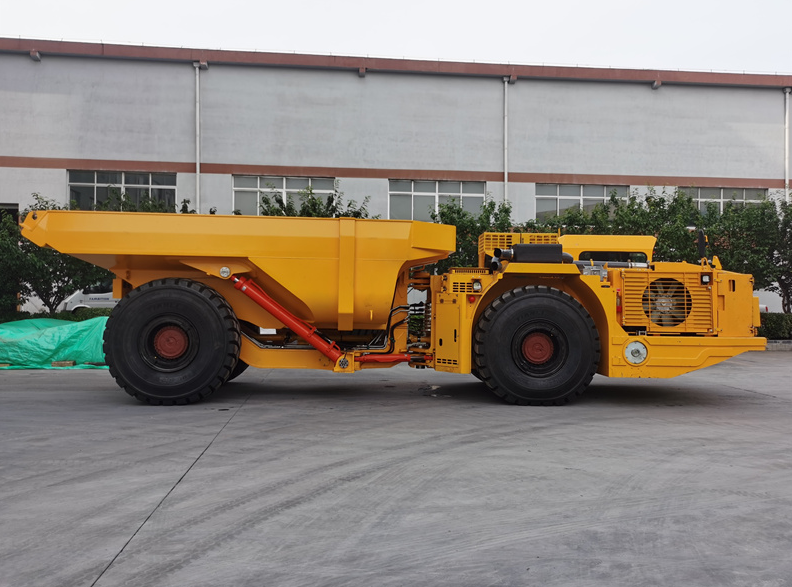
Surface and underground mining machines look fundamentally different. Subterranean equipment features a low height-to-width ratio to fit inside restrictive tunnel dimensions. Manufacturers utilize heavy-duty structural steel armor to protect vital components from constant rock impacts and abrasive conditions. Central oscillation joints allow these machines to articulate. This provides the tight turning radiuses necessary to navigate sharp corners and narrow drifts without striking the walls. You will notice that cabs are often side-mounted or positioned lower than the engine canopy to maximize overhead clearance. The tires are specialized, featuring slick or semi-slick treads with heavy sidewall protection to resist cutting from sharp blasted rock.
To understand the physical differences, consider the standard dimensions and operational parameters. Surface trucks build upward, utilizing massive dump boxes that sit high above the chassis. Underground trucks build outward and lengthwise. They keep the center of gravity as low as possible. This prevents rollovers on uneven, steep decline ramps. The structural integrity of the frame must withstand not just the payload, but the torsional stress of navigating uneven ground while fully loaded.
Feature | Surface Mining Equipment | Underground Mining Equipment |
|---|---|---|
Profile & Stance | Tall, wide, high center of gravity | Low-profile, elongated, low center of gravity |
Chassis Design | Rigid frame (mostly) | Articulated with central oscillation joint |
Operator Cabin | High visibility, top-mounted | Side-mounted or low-slung, heavily armored |
Exhaust System | Standard heavy-duty mufflers | DPF, wet scrubbers, specialized cooling |
Turning Radius | Wide, requires large open areas | Extremely tight, designed for narrow drifts |
Confined space operations dictate strict vehicle design parameters. Heat dissipation remains a major challenge. Underground environments trap thermal energy generated by engines, transmissions, and hydraulics. Without proper cooling, ambient temperatures rise to dangerous levels for personnel. Exhaust emissions, specifically particulate matter and nitrogen oxides, must remain below strict regulatory thresholds. Mine ventilation systems can only clear a specific volume of air per minute. If your fleet produces more emissions than the ventilation system can handle, you must halt production.
Noise reduction is equally critical. Tunnels act as echo chambers, amplifying engine and hydraulic noise. Specialized acoustic dampening around engine compartments prevents dangerous decibel levels from damaging operators' hearing. Fire suppression systems are mandatory. A vehicle fire underground is a catastrophic event. Machines come equipped with automated, multi-nozzle fire suppression systems that flood the engine bay and hydraulic compartments with chemical retardants at the first sign of abnormal heat.
Geological conditions dictate specific machine requirements. Hard rock mining differs significantly from soft rock or coal mining. In gassy environments where methane or coal dust is present, standard machinery poses a severe ignition risk. Operations in these zones require explosion-proof or flameproof enclosures for all electrical components. You cannot have an exposed starter motor or alternator sparking in a methane-rich atmosphere.
These specialized machines use water-cooled exhaust manifolds and wet scrubbers to ensure exhaust gases drop below ignition temperatures before leaving the tailpipe. Surface temperatures of the engine block and exhaust components are strictly regulated. If you deploy standard hard rock equipment into a coal seam, you risk immediate and catastrophic underground explosions. Compliance with MSHA or local equivalent explosion-proof ratings is non-negotiable.
Modern operations increasingly rely on automation to remove personnel from hazardous open-stope headings. Tele-remote operation allows operators to control machines from safe surface control rooms using live video feeds. This keeps workers away from unsupported ground and active drawpoints. Line-of-sight remote control enables operators to stand in a secure tunnel while driving a loader into an unsupported area to muck out ore.
Autonomous tramming systems allow vehicles to navigate haulage routes independently. The machine uses LIDAR and laser scanners to map the drift and drive itself from the loading point to the dump point. This increases tramming speeds, reduces collision risks, and allows for continuous operation during shift changes or blast clearance times when personnel cannot be underground.
LHD loaders perform the dual role of mucking out blasted ore from stopes and transporting it to ore passes or waiting haul trucks. These machines feature an elongated, low-profile bucket design that maximizes load capacity while maintaining a low center of gravity. Heavy-duty drivetrains and specialized high-breakout-force hydraulics allow LHDs to dig into dense, fragmented rock piles efficiently within tight headings.
The mucking cycle requires immense power. The loader must ram into a pile of blasted rock, curl the bucket to break the material loose, and reverse out of the heading. This places extreme stress on the boom arms, hydraulic cylinders, and front axle. LHDs use specialized Z-bar linkage or similar geometry to maximize breakout force. The buckets are often fitted with mechanical wear plates and cast heel shrouds to extend their lifespan in highly abrasive rock.
Approach the muck pile with the bucket flat and lowered to the floor.
Penetrate the pile using momentum and tractive effort.
Curl the bucket while simultaneously lifting the boom to break out the material.
Reverse from the heading while keeping the load low to maintain stability.
Tram to the dump point or waiting haul truck.
Haul trucks transport ore and waste rock up steep declines to the surface or primary underground crushers. These vehicles rely on robust, articulated frames to maintain traction and stability on uneven ground. The articulation joint ensures all wheels maintain contact with the floor, even when navigating heavily rutted or undulating ramps. This constant ground contact is vital for traction when hauling heavy loads up 15% to 20% grades.
Payload classes vary, but the 20 Ton Underground Mining Truck represents an operational sweet spot for mid-sized operations. It balances maneuverability in standard 4x4 meter drifts with highly efficient haulage volumes. This size ensures consistent material movement without requiring oversized tunnel development. Larger trucks require massive headings, which increases drilling, blasting, and ground support costs. The 20-ton class fits perfectly into standard development profiles while delivering excellent tons-per-hour metrics.
Drilling jumbos utilize electro-hydraulic systems for both face drilling during tunnel development and production drilling in longhole stopes. These machines feature multiple booms equipped with high-frequency rock drills. The operator positions the booms to drill a precise pattern of holes into the rock face. These holes are then loaded with explosives. Accuracy is critical; poor drilling leads to poor fragmentation and uneven tunnel walls.
Mechanized rock bolters and cable bolters follow the drills. They install ground support to stabilize tunnel roofs and walls. The bolter drills a hole, inserts a steel bolt or cable, and secures it with resin or cement grout. This pins the rock strata together, preventing collapses. Mechanical scalers, equipped with hydraulic breakers or scaling claws, safely remove loose rock from the roof and ribs after blasting. Scaling is a critical safety step before any personnel enter a newly blasted heading.
Utility vehicles form the logistics and infrastructure backbone of the mine. Without them, the production fleet stops. Many operations utilize modular cassette systems, featuring multi-purpose utility vehicles with swappable beds. Quick-change cassettes allow a single chassis to function as a scissor lift, fuel tank, or crane. This maximizes fleet utilization and reduces the total number of engines running underground.
Dedicated support vehicles include personnel carriers, explosive chargers, and mobile lubrication stations. Explosive chargers (often handling ANFO or emulsion) pump blasting agents directly into the drilled holes. Mobile lubrication stations travel to the production equipment, performing oil changes and greasing right in the drift. This eliminates the need to tram slow-moving equipment back to a central workshop for basic servicing.
The mining cycle splits into development and production phases. During development, drilling jumbos, LHDs, mechanical scalers, and bolters operate in a strict sequence to safely create ramps, drifts, and crosscuts. This phase establishes the necessary infrastructure to access the ore body. Development is entirely about advancing the tunnel. The rock removed is often waste rock, hauled to the surface or used as backfill in empty stopes.
The production phase focuses entirely on extraction. It involves a continuous cycle of mucking, loading, and hauling ore from the stopes to the surface or designated ore passes. In production, the goal is maximum tonnage. Equipment operates in concentrated areas, pulling blasted ore from drawpoints. The efficiency of the production phase dictates the profitability of the mine. Any breakdown here immediately impacts the daily revenue.
Efficient material transport relies on seamless interaction between LHDs and haul trucks at loading bays and muck piles. The LHD scoops the ore and dumps it into the truck bed. This interaction requires precise timing and adequate space. Loading bays must be excavated at regular intervals along the haulage ramp to allow trucks to park while being loaded.
As mines deepen, haulage challenges increase. Depth directly affects cycle times. A truck hauling from 200 meters deep completes far more cycles per shift than a truck hauling from 1,000 meters deep. Operations must evaluate the transition from ramp trucking to shaft hoisting at extreme depths. Traffic management also becomes critical. Vehicle size and speed dictate the need for bypasses, passing bays, and automated traffic control systems to prevent bottlenecks in single-lane ramps. A traffic jam underground halts all production.
Procuring Mining Equipment requires calculating the required turning radius and swept path against the mine design. Engineers must evaluate corner angles and drift profiles to ensure machines can navigate the site. You cannot buy a truck that physically cannot turn the corners of your decline ramp. Swept path analysis uses software to simulate the machine's footprint as it articulates through a turn.
Standard safety margins between the vehicle extremities and the tunnel walls must be strictly maintained. This prevents structural damage to the equipment and the tunnel support systems. If a truck rubs against the wall, it can tear out ventilation ducting, electrical cables, or water pipes. It can also damage the rock bolts holding the roof up. A minimum clearance of 0.5 to 1 meter on all sides is typically required, depending on local regulations.
Diesel engines offer proven reliability and lower upfront acquisition costs. They are the industry standard. However, they place a heavy burden on mine ventilation systems required to clear Diesel Particulate Matter and noxious gases. Supplying fresh air deep underground requires massive surface fans and extensive ducting. The electricity required to run these fans is often one of the largest operating expenses for a mine.
Battery Electric Vehicles provide zero exhaust emissions and generate significantly less heat. This drastically reduces ventilation demands. You can push deeper into the earth without needing to sink new ventilation shafts. However, implementing BEVs requires overcoming hurdles related to charging infrastructure installation, managing battery weight, and mitigating thermal runaway risks. You must build dedicated charging bays and ensure your underground electrical grid can handle the massive power draw required for fast charging.
Pass-matching is essential for operational efficiency. Loader bucket capacity must match truck payload accurately. For example, an LHD loader should ideally fill a haul truck in three to four passes. If it takes seven passes, the truck sits idle too long. If it takes one pass, the loader is likely too large for the drift or the truck is too small, wasting haulage potential.
Gradeability and braking are equally important. Steep ramp gradients impact the loaded speed of heavy haulers. A truck that crawls up a ramp at 3 km/h destroys your cycle times. Conversely, coming down a 15% grade fully loaded requires massive stopping power. Integrated wet multi-disc brakes and retarders are mandatory for safe, controlled descents. Standard dry brakes would overheat and fail within minutes under these conditions.
Operator safety relies on robust cabin standards. Roll-Over Protective Structures and Falling Object Protective Structures are mandatory to protect operators from rockfalls and vehicle rollovers. The cabin is the last line of defense if the roof gives way. Enclosed, climate-controlled cabins combat heat and dust exposure, keeping the operator alert and healthy throughout a 12-hour shift.
Air-suspended seating reduces vibration fatigue. Operating heavy machinery on rocky ground destroys spinal health over time without proper suspension. Multi-camera proximity detection systems eliminate dangerous blind spots around the machinery. These systems use radar or RFID tags to detect personnel on foot, automatically applying the brakes if a worker steps into the machine's path.
Underground breakdowns cause severe production halts and are notoriously difficult to service in tight drifts. You cannot easily tow a 40-ton machine up a 15% grade. To mitigate this risk, operations must evaluate vehicles for modular component design and ground-level service points. Mechanics need to access filters, fluid fills, and diagnostic ports without climbing over the machine in a cramped tunnel.
Onboard diagnostic systems that allow for rapid in-situ repairs help technicians identify and resolve mechanical faults quickly. If a transmission fails, modular design allows the maintenance crew to unbolt the entire transmission unit, swap it with a replacement, and send the broken unit to the surface for rebuild. This gets the machine back into production much faster than rebuilding components in the dirt.
Procuring advanced equipment that outpaces mine infrastructure creates massive operational delays. Deploying electric fleets without adequate electrical grid capacity or fast-charge stations renders the machines useless. You cannot charge a fleet of BEVs on a grid designed for a few water pumps and drill jumbos. Conduct a thorough site audit prior to procurement.
Ensure the power supply, ventilation shafts, and underground maintenance bays can fully support the specific vehicle class being introduced. If you buy larger trucks, you must ensure your underground workshop bays are physically large enough to accommodate them. You must also verify that your primary crusher or ore pass grizzlies can handle the larger rock sizes dumped by bigger buckets.
Extended downtime due to supply chain delays for highly specialized underground components can cripple daily production. If you are waiting three weeks for a proprietary hydraulic cylinder, that machine is burning money. Prioritize manufacturers with localized service centers and guaranteed parts availability. They should hold critical spares in a warehouse near your site.
Comprehensive technician training programs provided by the manufacturer ensure site mechanics can perform routine maintenance and complex repairs efficiently. The OEM should send trainers to the site during the commissioning phase to walk your maintenance team through the specific quirks and service procedures of the new equipment.
An underground mining vehicle serves as a highly specialized asset dictated by the geological, structural, and atmospheric realities of the mine. Procurement teams must base decisions on a strict matrix of drift dimensions, required throughput, ventilation capacities, and pass-matching efficiency. To ensure successful integration, follow these actionable steps:
Request detailed swept-path simulations from manufacturers to confirm tunnel compatibility before purchase.
Conduct a comprehensive site audit to verify ventilation and electrical infrastructure capabilities.
Match loader bucket sizes directly to haul truck payloads to optimize cycle times and reduce idle waiting.
Arrange site visits to test equipment in comparable subterranean conditions before finalizing procurement.
A: It is a purpose-built machine designed with a low profile, heavy-duty armor, and articulated steering to operate safely and efficiently within confined subterranean tunnels.
A: Articulated chassis allow the front and rear sections of the vehicle to pivot independently. This provides a much tighter turning radius, enabling the machine to navigate narrow drifts and sharp corners.
A: BEVs produce zero exhaust emissions and generate less heat than diesel engines. This significantly reduces the demand on the mine's ventilation system and improves overall air quality for workers.
A: Pass-matching is the process of aligning a loader's bucket capacity with a haul truck's payload. The goal is to fill the truck in an optimal number of passes, usually three to four, to maximize loading efficiency.
A: Underground tunnel floors are often uneven, rocky, and muddy. Adequate ground clearance prevents the vehicle's undercarriage from dragging, which can damage vital drivetrain components and cause the machine to get stuck.
A: Modern cabins feature ROPS and FOPS certifications to protect against rollovers and rockfalls. They also include climate control, air-suspended seats, and proximity detection systems to improve visibility and reduce fatigue.
