
- All
- Product Name
- Product Keyword
- Product Model
- Product Summary
- Product Description
- Multi Field Search


Views: 0 Author: Site Editor Publish Time: 2026-11-11 Origin: Site


Unscheduled downtime severely damages profitability in continuous underground mining operations. When an Epiroc MT2010 stops moving ore, you lose revenue every minute. Often, the root cause of these sudden delays traces back to a single failed valve. Sourcing the exact hydraulic, pneumatic, or brake valve is absolutely critical for maintaining safety and operational efficiency. You simply cannot afford guesswork when replacing high-pressure components in harsh environments. This guide provides a clear, evidence-based framework to streamline procurement and reduce mechanical risks. We will walk you through the precise steps necessary to identify the right components, ensuring seamless repairs and minimal delays. You will learn how to locate your machine data, navigate official technical manuals, and successfully vet suppliers. By following these proven methods, you protect your fleet from dangerous mismatches, optimize your maintenance budget, and keep your heavy machinery actively producing.
Accurate part identification requires cross-referencing the machine’s serial number with the official Epiroc parts catalog.
Valves must be categorized by system (hydraulic, braking, transmission) to assess operational criticality and safety compliance.
Evaluating OEM versus aftermarket options requires balancing immediate availability with long-term reliability and warranty coverage.
Procuring a valve is only step one; verifying associated seals, calibration specs, and system compatibility is essential before installation.
Incorrect valve flow rates or pressure ratings immediately compromise hydraulic efficiency. An underground truck relies on precisely calibrated fluid dynamics to lift heavy payloads and steer through narrow drifts. If you install a valve with a lower flow capacity, it restricts hydraulic movement. This restriction generates immense heat. Heat degrades hydraulic fluid and destroys delicate seals across the entire circuit. Eventually, this cascade effect leads to catastrophic system failure. You might save a few days by installing whatever component is currently in stock. However, a mismatched valve often destroys expensive pumps and cylinders down the line.
Safety remains the absolute highest priority in subterranean environments. Using unverified components in critical safety systems poses massive risks. Your braking and steering circuits require exact pressure tolerances. If a replacement service brake modulator leaks pressure internally, the truck loses braking power. An operator descending a steep grade relies entirely on this regulated pressure. You must never compromise on these essential safety layers. When you buy underground haul truck parts, always demand verifiable compliance with original manufacturer safety standards.
Downtime carries a steep price tag in the mining sector. Maintenance managers often feel immense pressure to get equipment running immediately. You must carefully weigh the cost of extended lead times against the risks of rushed repairs. Waiting three days for the correct valve costs money. Yet, the exponential cost of installing an incompatible part is far worse. An incorrect valve can trigger secondary failures, requiring a week of intensive labor to fix. Rushing a mismatched installation creates a false economy. We highly advise prioritizing exact specifications over mere availability.
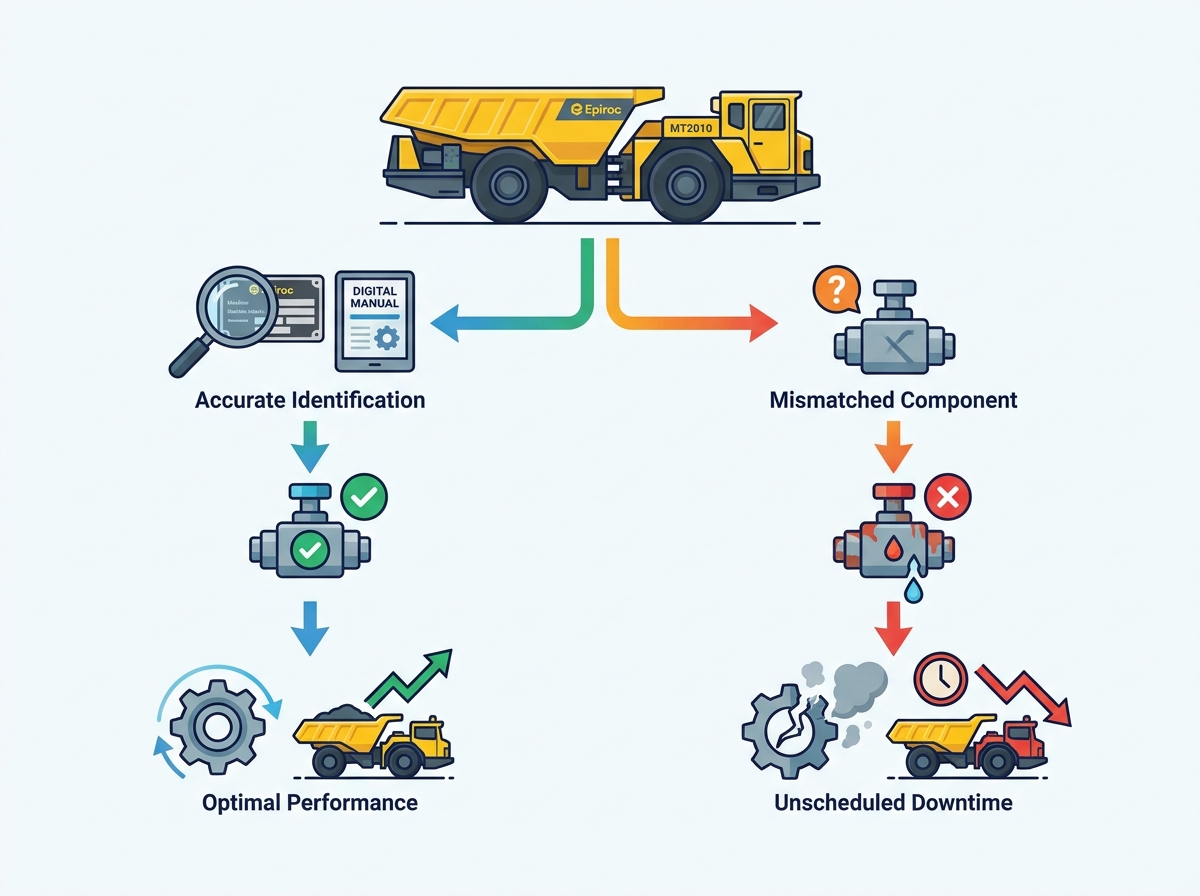
Successful Epiroc MT2010 valve part identification begins directly at the machine. You must first locate the equipment data plate. Mechanics usually find this metal tag affixed near the articulation joint or inside the operator cabin base. The data plate contains the Product Identification Number (PIN) or serial number. This number is your master key. Epiroc updates machine designs periodically, meaning a Generation 1 truck differs from a Generation 2 model. Using the precise PIN ensures generation compatibility and eliminates initial procurement errors.
Once you secure the PIN, consult the official technical documentation. You can utilize the digital Epiroc Techinfo portal or refer to physical parts catalogs. Enter the serial number to access the correct schematics. Navigate to the relevant fluid power section. Trace the hydraulic or pneumatic lines on the diagram until you reach the exact failed component. The manual provides an exploded view of the assembly. This view breaks down the main valve body, internal spools, and outer O-rings. Always document the primary part code listed in this diagram.
Digital manuals are excellent, but physical inspection validates your findings. Heavy grease and mud often obscure critical identification markers. Clean the failed valve body thoroughly using an industrial solvent. Look closely for original manufacturer stamps. Many OEM valves feature secondary brand markings, such as Danfoss or Rexroth. You should also search for serial codes or legacy part numbers etched directly into the metal housing. Comparing these physical stamps against the manual confirms you are examining the correct unit.
Manufacturers frequently upgrade components to resolve known engineering issues. You might discover the manual lists a different number than the stamp on your valve. We call these superseded parts. Epiroc handles version control strictly. If a component is superseded, the new iteration typically retains the original mounting footprint. However, it often features enhanced internal seals or better pressure tolerances. When you encounter a superseded part, contact technical support to confirm compatibility. Do not automatically assume an updated code indicates the wrong component.
When evaluating Minetruck MT2010 replacement parts, you must categorize them by their specific mechanical function. Different systems carry vastly different risk profiles. Understanding these distinctions helps you prioritize your sourcing strategy effectively.
Identifying Components: Look for directional control valves, primary pressure relief valves, and hoist system diverters. These units manage the heavy lifting and frame articulation.
Key Evaluation Metric: Flow capacity and maximum pressure tolerances dictate success here. The valve must handle intense pressure spikes without bypassing fluid.
Common Mistake: Installing a relief valve rated for lower pressure causes the hydraulic system to stall under a full payload.
Identifying Components: Essential units include accumulator charging valves, pedal actuators, and service brake modulators. These parts reside within the enclosed safety circuit.
Key Evaluation Metric: We require absolute zero-tolerance for pressure leakage. Strict OEM compliance is highly recommended to guarantee reliable stopping power.
Common Mistake: Using uncertified aftermarket brake valves introduces dangerous lag times during emergency stops.
Identifying Components: Key parts involve transmission shift control valves and accessory pneumatic solenoids. These govern gear changes and minor air-powered accessories.
Key Evaluation Metric: Electronic Control Module (ECM) compatibility represents the most crucial factor. Solenoid voltage must match the existing wire harness perfectly.
Common Mistake: Splicing wiring harnesses to fit a mismatched solenoid can fry the main transmission ECM.
Below is a quick reference guide detailing crucial parameters across the vehicle's primary fluid systems.
Table 1: MT2010 Valve System Parameters
Valve System | Primary Function | Critical Specifications | Risk of Mismatch |
|---|---|---|---|
Hydraulic Control | Steering and hoist operations | Flow rate (L/min), Burst pressure | Overheating, cylinder drift, seal failure |
Braking Circuit | Accumulator charge, modulation | Zero internal leakage, rapid response | Loss of braking power, safety incidents |
Transmission | Gear shifting, clutch engagement | Solenoid voltage, ECM signal match | Erratic shifting, ECM damage |
Securing parts directly through authorized Epiroc channels offers distinct advantages. Finding your precise MT2010 valve part number in an OEM catalog guarantees a perfect specification match. OEM parts maintain official warranty coverage and preserve the machine's resale value.
Pros: Guaranteed specification match, official manufacturer warranty, preserved machine resale value. You eliminate engineering guesswork entirely.
Cons: Premium pricing significantly impacts maintenance budgets. Additionally, regional supply chain bottlenecks can cause frustrating delivery delays.
Many maintenance managers explore aftermarket solutions to bypass long OEM lead times. High-tier aftermarket manufacturers often build components to identical tolerances as the original parts. However, this route requires exceptional diligence.
Pros: Exceptional cost efficiency. You often secure faster availability through specialized distributors holding local inventory.
Cons: Quality control varies wildly among aftermarket brands. Sourcing here requires strict vendor vetting to avoid substandard materials.
If you choose aftermarket options, you must scrutinize your suppliers aggressively. Demand verifiable ISO certifications from any new vendor. Request transparent warranty terms in writing before issuing a purchase order. The supplier must provide explicit statements of compatibility linked directly to your exact part number. Never accept vague promises like "fits most mining trucks." Ask for material data sheets and references from other underground operators. Thorough vetting prevents catastrophic failures down the road.
Procurement success does not end at the loading dock. Before your technicians begin wrenching, perform rigorous pre-installation checks. Place the new valve directly beside the failed unit on a clean workbench. Verify that the new unit matches the exact port configuration, thread pitch, and mounting footprint. Ensure the electrical connectors match the machine's harness perfectly. A simple visual comparison often catches shipping errors before you tear apart the hydraulic circuit.
Replacing a major valve requires simultaneous replacement of ancillary parts. You must source new O-rings, flange gaskets, and hydraulic filters simultaneously. Reusing a compressed, heat-cycled O-ring guarantees an immediate high-pressure leak. Fresh hydraulic filters capture any contamination introduced during the repair process. Treat these small seals and filters as mandatory insurance policies for your expensive new valve.
Mechanical valves usually function perfectly right out of the box. However, modern equipment relies heavily on electronics. Some electronic or proportional valves require software calibration post-installation. The machine’s ECM needs to learn the new component's exact resistance and flow characteristics. Acknowledging this requirement prevents erratic machine behavior. Ensure your maintenance team has access to the correct diagnostic software and cables before beginning the repair.
Stop relying on fragmented emails and verbal requests. Compile the machine PIN, the verified part number, and your required lead time into a single document. Take photographs of the failed component's data plate. Submit standardized Requests for Quotation (RFQs) to a minimum of two vetted suppliers. Comparing multiple structured quotes ensures you secure the best balance of price, quality, and delivery speed.
Successful procurement directly protects your bottom line and operator safety. It relies entirely on precise identification and rigorous supplier evaluation. You must cross-reference serial numbers, physically inspect failed components, and categorize replacement parts by their system criticality. Understand that rushing a mismatched installation always costs more than waiting for the correct specification. We strongly recommend prioritizing exact specification matches and supplier transparency over immediate, unverified availability. Taking these methodical steps protects asset uptime, extends machinery lifespan, and ensures a safer underground environment.
A: You can access the official Epiroc Techinfo portal online using your company credentials. Alternatively, contact your authorized regional dealer directly. Always provide your machine's unique Product Identification Number (PIN) to receive the exact documentation matching your truck's generation.
A: We advise extreme caution here. Using non-OEM brake components carries severe safety risks due to potential internal pressure leaks. You should only use aftermarket options if the supplier is a verified, direct OEM manufacturer for that specific brake valve.
A: First, contact official technical support. Manufacturers regularly supersede obsolete parts with updated codes. Support engineers can verify the new superseded part number or direct you toward an authorized retrofit kit designed for your specific hydraulic circuit.
A: Standard mechanical hydraulic valves do not require software calibration. However, electronic proportional valves linked to the ECM often do. These electronic units usually require basic setup and stroke calibration by a certified technician using diagnostic software.
